Know it’s really them,
on every call.
Fraudsters pretend to be your organisation to your customers, your customers to your staff, and your managers to your own team. Hongi gives each of those calls a short spoken check that a cloned voice or a spoofed number alone can’t pass.
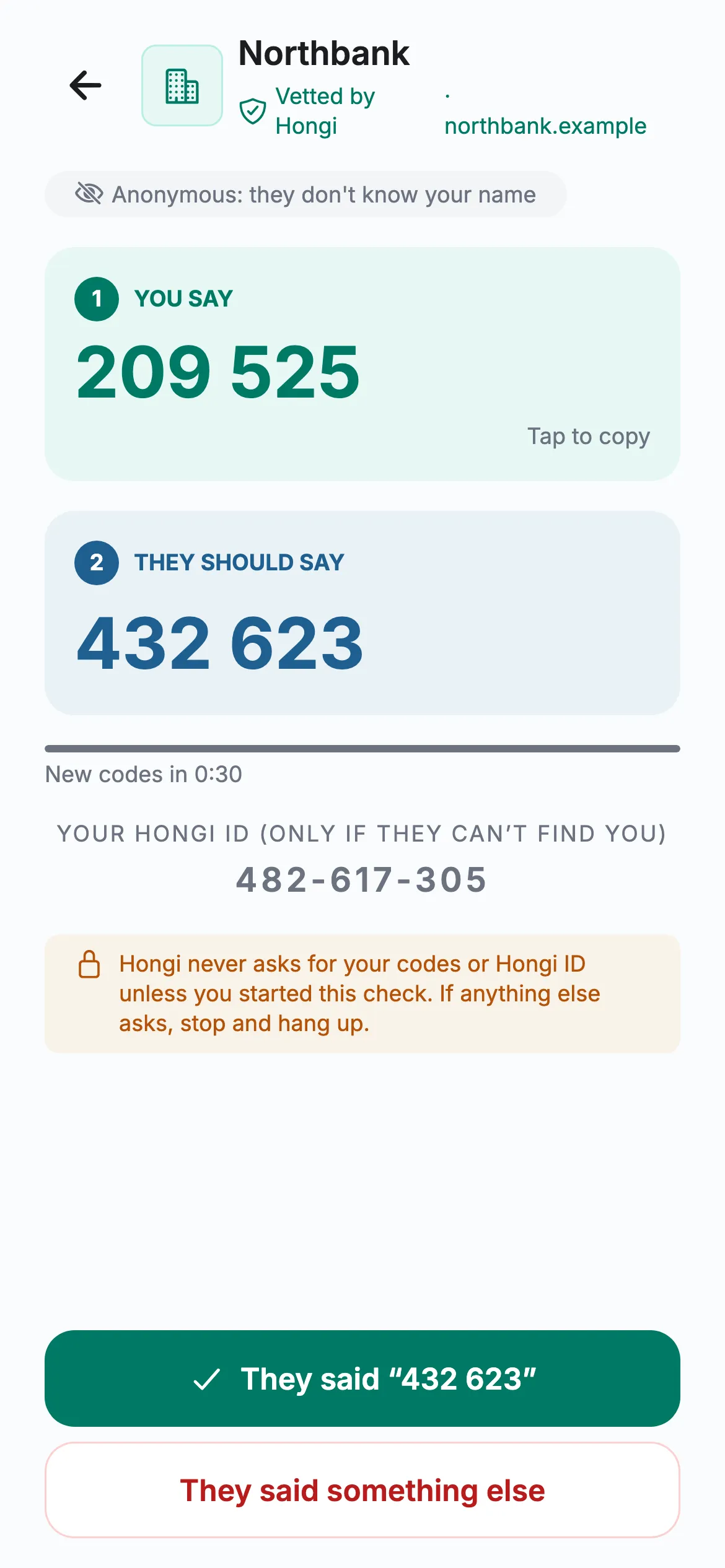
- 1The person reads first209 525 Your agent types it in.
- 2Your agent reads back432 623 Their phone shows what to expect.
From anyone who gets your call to the colleague next door
Every Hongi check works the same way: each side reads a different short code, new every 30 seconds. What changes is who is on the other end.
Let anyone check that it’s really you
- Against
- Fake bank and fake authority calls
- Who checks
- Anyone with the free app. No account; they stay pseudonymous to you
- Codes
- 6 digits · the person reads first
You and your customer check each other
- Against
- Account takeover, the fake advisor
- Who checks
- Your named customers, paired once by QR code, link or CSV
- Codes
- 6 digits · your organisation speaks first
Colleagues check each other
- Against
- CEO and CFO fraud, the fake IT helpdesk
- Who checks
- Every participating employee, with no pairing step
- Codes
- A word and three digits · works offline
Two different codes, read aloud, new every 30 seconds
Each side says its own code and expects the other’s. Who speaks first depends on who is calling whom.
Hongi AnyoneLive
- 1The person reads first209 525 Your agent types it in.
- 2Your agent reads back432 623 Their phone shows what to expect.
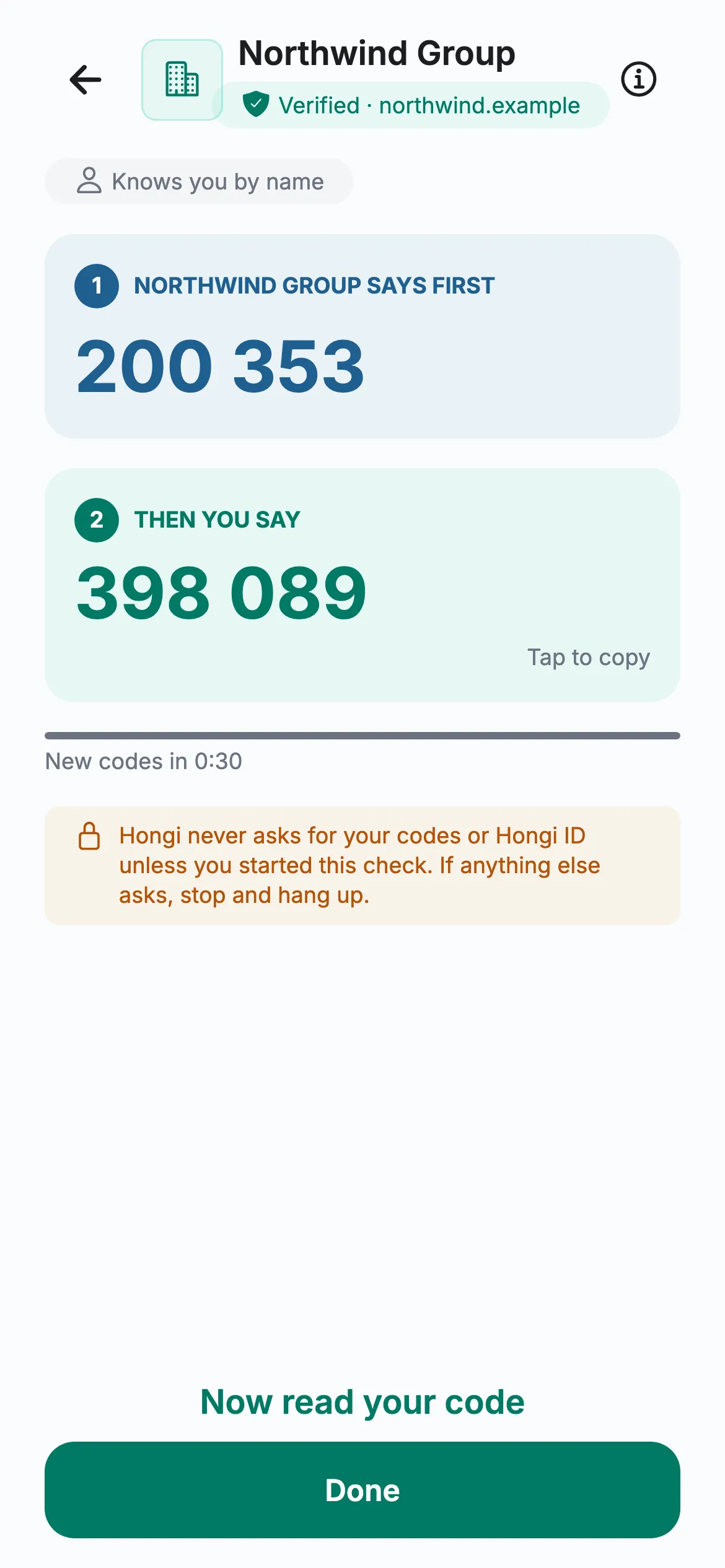
Hongi CustomersAvailable for pilots
- 1Your agent speaks first200 353 It proves the call comes from you.
- 2Your customer reads back398 089 Your agent checks it.
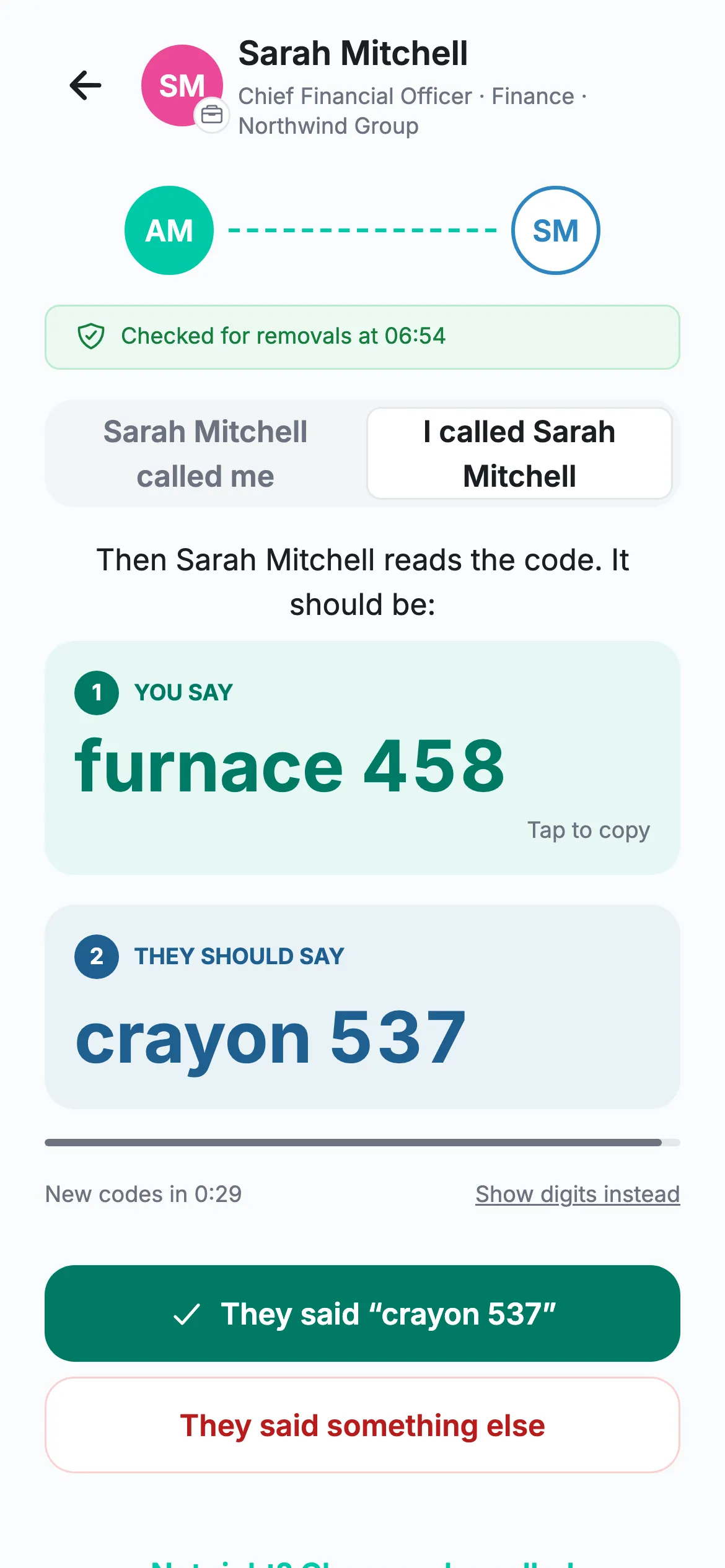
Hongi WorkAvailable for pilots
- 1The caller reads firstfurnace 458 After calling back on a known number.
- 2The colleague reads theirscrayon 537 Your phone shows what it should be.
Real Hongi app screens with fictional demo data
Built so a stolen voice isn’t enough
Three of the five rules every Hongi check follows.
The secret is never spoken
People read short codes made from a secret that is never shown, typed, spoken or sent. Overhearing a call gives nothing reusable.
Codes expire in 30 seconds
A recorded code is worthless within about a minute and a half.
Two different codes
Hearing one side doesn’t reveal the other, so an impostor can’t simply repeat what they heard.
Start where the calls hurt most
Banks & insurers
This is your bank’s fraud team. Move your savings to this safe account.
Utilities & telecom
I’ve got a new phone. Please move my number and update my details.
Public services
We’re calling from the tax office about a problem with your return.
Finance teams & CEO fraud
It’s the CEO. I need a confidential transfer out today.
IT helpdesk
IT here, we’re resetting your account. Read me the code you just received.
What a pilot looks like
Bring one real scenario; we set it up with you.
Bring one real scenario
A fraud you have seen or fear: a fake advisor call, a payment request from “the CFO”, a helpdesk reset. We look at it together.
We set it up with you
Your listing, your first customer invitations or your colleague setup, in the Hongi portal, with the people who will use it.
Use it on real calls
Your team checks real calls with the app and the portal. Then we look at what worked, and what didn’t, together.
Tell us which call worries you most.
A fake advisor, a payment request from “the CFO”, a helpdesk reset: we set up a pilot around it with you. Or email info@hongi.io.
Just want to protect your family?
Get the free Hongi app. Pair once with the people you trust; on any call, you each read a different word. No account.